en
en



Magazine
“Old-Man Smell” Is Optional: How Scent Chemistry Changes After 50

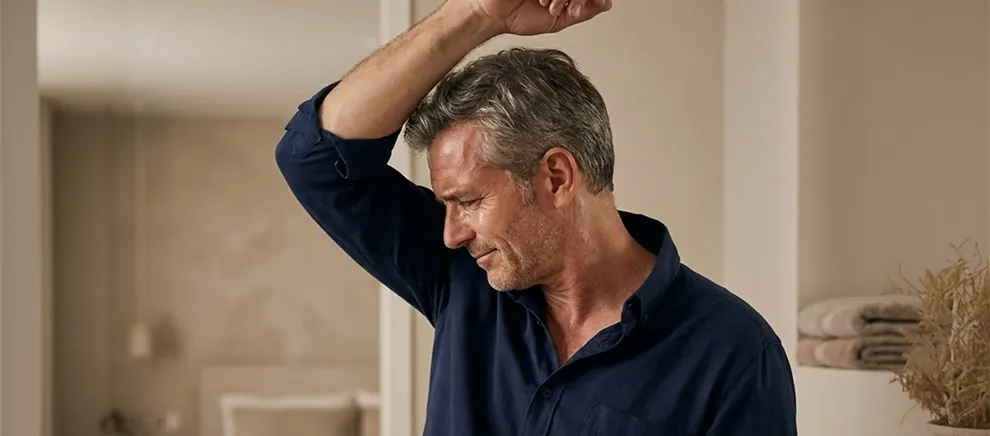
Most men don’t notice the change right away. It’s not dramatic. There’s no sudden moment in front of the mirror. Just a faint sense that something is different — a musty smell on a scarf, a shirt that doesn’t feel quite “fresh” by evening, a cologne that no longer smells the way it used to.
It’s often brushed off as stress, a wrong choice of laundry detergent, or a figment of your imagination. But what’s really happening is scientific – and down to chemistry.
Your Skin Starts Playing by New Rules
After 50, the skin quietly rewrites its operating manual. Oil production slows, then shifts. Antioxidant levels drop. Cell turnover becomes less efficient. Together, these changes create the perfect conditions for compounds like nonenal — a lipid-based odor molecule that behaves very differently from the odors most of us are familiar with in sweat.
Nonenal doesn’t wash away easily. It lingers. And because it’s oil-soluble, it clings to skin, fabric, and even the memory of a room.
That’s where the myth of “old-man smell” comes from — not from neglect, not from poor hygiene, but skin chemistry evolving faster than most routines do.
Why Traditional Deodorants Fall Short
Regular deodorants — especially those you’ve used for years — are designed for younger skin. They mask surface sweat and block bacteria temporarily. For men in their 20s and 30s, they do a decent job. But they don’t address:
- Oxidized lipids that cling to skin
- Sweat and oils deeply bound in pores
- The way older skin chemistry absorbs and holds scent
That’s why a shower and your usual stick deodorant might still leave you smelling “off” by midday. The solution isn’t masking with a stronger fragrance — it’s changing the underlying chemistry.
A Better Approach: Targeted Scent Chemistry
At Particle, we believe scent should be intentional — not accidental. That’s why we formulated Deodorant, Gravite Cologne, and our newest fragrance, Varros, with your evolving body chemistry in mind. Together, they create a layered, effective strategy.
We start by neutralizing what doesn’t belong, rather than covering it up.
A deodorant that respects mature skin chemistry — like Gravité Deodorant — helps create a clean baseline without over-stripping or overwhelming the skin.
From there, fragrance becomes less about projection and more about harmony. A scent like Gravité is designed to sit closer to the skin, anchoring itself without fighting the natural oils beneath it. The result is something steadier, warmer, and more consistent throughout the day.
And then there’s the final layer — the subtle depth that extends a presence rather than announces it. Used sparingly, something like Varros adds dimension, rounding out the edges rather than sharpening them.
None of this is about smelling like someone else. It’s about smelling like yourself — upgraded.
Why Subtlety Wins
One of the biggest shifts that happens with age is perspective. Loud becomes less impressive. Precision becomes more attractive. The same applies to scent. The goal isn’t to walk into a room and be noticed immediately. It’s to leave an impression — something clean, composed, intentional.
When scent chemistry is working with you rather than against you, people don’t think “fragrance.” They think of presence. They lean in instead of stepping back.
The Takeaway
Aging doesn’t doom you to a particular musty smell. It simply asks for a smarter approach. Your skin is changing. Your chemistry is shifting. The routines that once worked effortlessly may need refinement.
With thoughtful layering, gentler formulations, and fragrances designed to evolve with you, the much-dreaded “old-man smell” becomes what it always should have been: a myth. A problem for other people. Something optional that won’t hold you back.